What Is a Resilient Oracle Architecture?
A resilient oracle stacks several independent price sources behind one Solidity interface and validates them against each other before returning a value. On DeFi lending, that difference matters at nine-figure scale: Chainalysis recorded $2.17B stolen from services in H1 2025 alone (Chainalysis, July 2025). RheoFi's oracle inherits the ResilientOracle pattern and hardens it for XRPL EVM.
Why a single feed is not enough
A lone push oracle has three failure modes that a lender cannot tolerate. First, staleness: the last update predates the current block by more than the configured window, and the reported price no longer reflects the market. Second, upstream compromise: a data provider is bribed, misconfigured, or paused. Third, thin-market manipulation: an attacker moves the reference exchange with a single flash-loan-sized trade. Any one of these produces bad debt or unfair liquidation. Stacking feeds lets the contract reject the outlier before it settles.
How RheoFi frames the problem
RheoFi treats every getPrice(address asset) call as a security-critical read. The Comptroller cannot value collateral, compute a health factor, or execute a liquidation without one. The Resilient Oracle sits between the Comptroller and every underlying feed, so the failure surface is one audited contract rather than one push feed per market.
When we disclosed the full oracle stack in our whitepaper: Context: RheoFi published its whitepaper disclosing the full oracle stack alongside the inherited audit lineage. Finding: 15 prior security engagements across 6 firms (PeckShield, Hacken, Certik, Quantstamp, FairyProof, Pessimistic) cover the oracle, comptroller, and isolated pool core. Result: Every mainnet oracle path starts from an audited baseline before RheoFi's own audit passes, cutting time-to-safety review for integrators.
Resilient Oracle vs Single-Feed Oracle Design
Legacy money markets often read one push feed per asset with no anchor check. The Mango Markets exploit remains the reference case: $115M of bad debt traced to a manipulated MNGO price accepted by the lending contract at face value (Rekt News, October 2022). RheoFi's Resilient Oracle rejects that pattern by design.
Head-to-head comparison
| Feature | RheoFi Resilient (3-tier) | Single-feed money markets | Median-of-N designs |
|---|---|---|---|
| Primary source | MAIN (Chainlink push where live) | 1 push feed | Aggregate of N |
| Anchor validation | BoundValidator with upper and lower bounds | None | Implicit in median |
| Fallback on staleness | PIVOT then FALLBACK | Revert or halt market | Depends on quorum |
| Per-pool oracle config | Yes, isolated per market | No, protocol-wide | Rare |
| Audit lineage on contract | 15 audits across 6 firms | Varies | Varies |
| Governance surface | ACM plus Timelock | Multisig | Multisig |
What the comparison implies for depositors
Depositors in an isolated pool inherit that pool's oracle policy and nothing else. A misconfigured feed on a long-tail asset cannot poison prices in the XRP or rUSDC pool. The blast radius is a design property, not a runtime accident.
Why Oracle Design Matters for DeFi Lending in 2026
Rekt's leaderboard tracks over $21B in cumulative DeFi losses across roughly 310 incidents as of July 2026 (Rekt News, July 2026). Oracle manipulation and price-feed lag stay in the top three attack categories every year. RheoFi treats oracle policy as first-class governance, not a config file.
Loss data keeps pointing at oracles
Chainalysis measured over $2.17B stolen from crypto services in H1 2025 alone, exceeding the full-year 2024 services total (Chainalysis, July 2025). Post-mortems repeatedly cite oracle staleness or manipulation as the root cause on the lending side. A protocol that reads one feed per asset is one bad push away from an insolvency event.
Isolated pools change the impact math
Because RheoFi separates every market into its own Comptroller and its own risk fund, an oracle incident on one pool cannot bleed into another. That property is only useful if the oracle on each pool is itself defensible. The Resilient Oracle is what makes isolation protective in practice, not only on paper.
XRPL EVM changes the tempo, not the threat model
XRPL EVM produces blocks about every 6 seconds, measured against the public RPC in September 2026, so a stale price ages faster in wall-clock terms than on a 12-second chain. RheoFi encodes that reality in per-asset maxStalePeriod values. Faster settlement magnifies the cost of a bad read, which is why the three-tier check is the default, not an opt-in.
How Does RheoFi's Three-Tier Oracle Work?
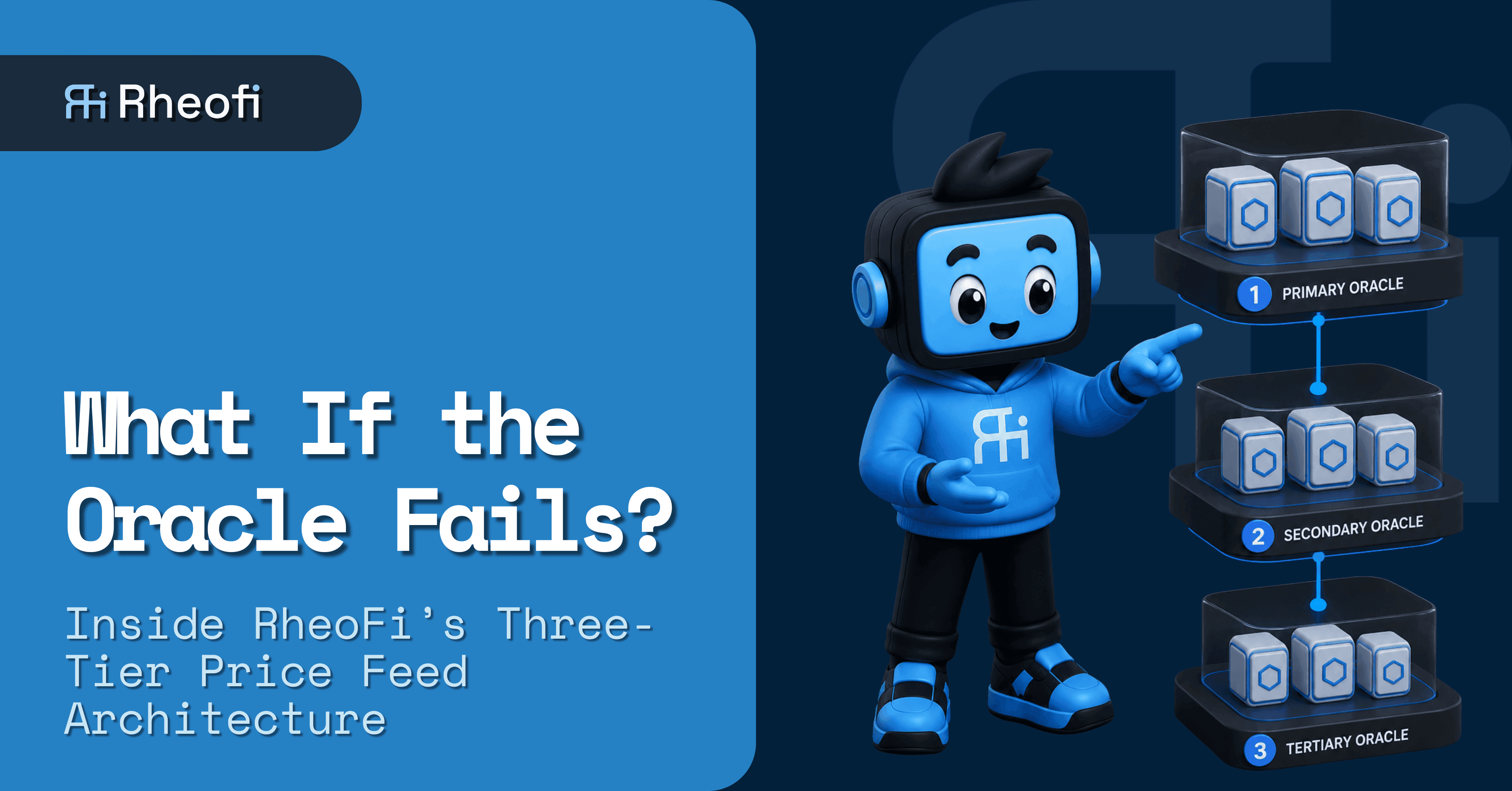
RheoFi's ResilientOracle contract exposes a single getPrice(address asset) entry point that routes 100% of price reads through 3 tiers before returning, per the RheoFi Whitepaper v1.0. Each tier has an isolated failure boundary, and the BoundValidator gates acceptance whenever more than one tier is live.
The three tiers and the anchor check
MAIN is the primary source, typically a Chainlink push feed with a per-asset maxStalePeriod. PIVOT is a governance-selected reference used to anchor MAIN's reading, often a second on-chain source with different provenance. FALLBACK is a redundant feed used only if MAIN is disabled or reverts. The BoundValidator compares MAIN against PIVOT and rejects any reading outside the configured upper and lower deviation bounds.
Pseudocode of the read path:
function getPrice(address asset) external view returns (uint256) {
    TokenConfig memory cfg = tokenConfigs[asset];

    (uint256 mainPrice, bool mainValid) = _tryOracle(asset, OracleRole.MAIN);
    (uint256 pivotPrice, bool pivotValid) = _tryOracle(asset, OracleRole.PIVOT);

    if (mainValid && pivotValid) {
        require(
            boundValidator.validatePriceWithAnchorPrice(asset, mainPrice, pivotPrice),
            "MAIN outside PIVOT bounds"
        );
        return mainPrice;
    }

    if (mainValid && cfg.enableFlagsForOracles[uint256(OracleRole.PIVOT)] == false) {
        return mainPrice;
    }

    (uint256 fallbackPrice, bool fallbackValid) = _tryOracle(asset, OracleRole.FALLBACK);
    require(fallbackValid, "no valid oracle");
    return fallbackPrice;
}
Where staleness is enforced
The ChainlinkOracle adapter reads latestRoundData() from the aggregator and reverts if block.timestamp - updatedAt > maxStalePeriod[asset]. That check runs before the BoundValidator ever sees the price. Governance sets maxStalePeriod per asset via the Access Control Manager and the Timelock, so no single admin can widen the window unilaterally.
Components of the RheoFi Oracle System
The Resilient Oracle is a family of contracts and adapters covered by 15 prior security engagements across 6 firms, spanning the same codebase that answers a threat surface where Chainalysis logged $2.17B stolen from services in H1 2025 (Chainalysis, July 2025). Components below map to the inherited oracle source tree.
Contract-by-contract map
- ResilientOracle is the top-level router. Comptroller calls land here.
- ChainlinkOracle adapter reads push feeds with per-asset
maxStalePeriod. - BoundValidator enforces the upper and lower deviation between MAIN and PIVOT.
- BinanceOracle adapter provides a PIVOT source using an external signed price.
- PythOracle adapter integrates Pyth pull feeds where the market warrants it.
- RedStoneOracle adapter supports on-demand data with attested payloads.
- AccessControlManager guards every setter (add oracle, disable tier, change bounds).
- Timelock delays every governance change to the oracle configuration.
- PriceFeedRegistry persists per-asset TokenConfig mappings across upgrades.
- UpgradeableProxy (UUPS) lets governance ship fixes without redeploying pools.
Roles and permissions
The ACM restricts each mutating function to a specific role: an oracle admin can add a feed, a pause guardian can disable a tier for one asset, and the Timelock owns bound changes. That separation prevents a single compromised key from flipping every pool's oracle policy in one transaction.
Interface surface for integrators
Every adapter conforms to a small interface that returns a fixed-point price and reverts on invalid state. That uniformity matters for the Comptroller: it can swap MAIN adapters (Chainlink today, another provider tomorrow) without redeploying pool logic. Integrators reading through the XRPL EVM developer docs get an EVM-standard surface with no chain-specific quirks in the oracle path, which shortens the audit checklist for any downstream integrator.
Upgradeability and event surface
Every setter emits an indexed event so off-chain monitors can reconstruct the full history of a pool's oracle configuration. That matters for post-incident forensics: if a price ever settles at the edge of the BoundValidator bounds, an auditor can pull the exact TokenConfig that governed the read. UUPS proxies let governance patch the ResilientOracle contract itself without touching the underlying pools, and each upgrade goes through the Timelock delay so watchers get notice before the change activates. The composite result is an oracle stack that behaves like protocol infrastructure rather than a hidden config file.
Ship Safer Oracles on XRPL EVM Faster
RheoFi ships the Resilient Oracle stack as the default price layer for every isolated pool on the XRPL EVM Sidechain.
Open the testnet app to read live prices, or clone the interfaces from the docs and integrate against them today.
Every oracle path inherits from 15 audits across PeckShield, Hacken, Certik, Quantstamp, FairyProof, and Pessimistic.
How to Integrate the RheoFi Oracle in a Solidity Contract
Integrating the Resilient Oracle from an XRPL EVM contract takes 5 core steps and does not need your own feed, against a category that cost DeFi over $21B in cumulative losses per the Rekt Leaderboard as of 2026. The pattern matches the RheoFi Whitepaper v1.0 and works for lenders, vaults, and liquidator bots.
Prerequisites
You need the deployed ResilientOracle address for the target pool, the underlying asset address, and a Solidity toolchain configured for the XRPL EVM RPC. All bytecode is EVM-standard, so Hardhat or Foundry both work.
Step-by-step integration
- Import the interface:
import { IResilientOracle } from "@rheofi/oracle/IResilientOracle.sol"; - Store the oracle address at construction:
oracle = IResilientOracle(_oracle); - Read a price at call time:
uint256 price = oracle.getPrice(asset); - Handle reverts: wrap the call in
tryor check the revert reason for"no valid oracle"before proceeding. - Never cache the price across blocks; the chain's roughly 6-second cadence means a cached value stales quickly.
- Convert the returned 18-decimal fixed-point value into your accounting units before comparing to notional balances.
- For tests, mock the oracle at the interface level; do not fork mainnet feeds in unit tests.
Gas notes and testnet measurement
Gas for a getPrice call is an engineering estimate that depends on how many tiers execute and whether the adapter reads Chainlink, Pyth, or another source. Measure against your testnet run before assuming a number for production accounting. The whitepaper does not benchmark oracle read gas, so any figure attributed to it would be wrong.
Risks and Security in Oracle Design
Oracle-related exploits in DeFi have produced $115M of bad debt on a single incident and appear in the top-severity category on nearly every post-mortem tracker (Rekt News: Mango Markets, October 2022). RheoFi's mitigations map one-to-one to the failure classes builders should expect on a new chain.
Smart contract risks and the audit baseline
The Resilient Oracle inherits from a codebase covered by 15 audits across 6 firms as disclosed in the whitepaper. Every RheoFi-specific delta ships through the same firms plus internal review before mainnet. The UUPS proxy pattern lets governance patch a discovered issue without redeploying every isolated pool, which reduces the cost of a fast response.
Oracle-specific failure modes and RheoFi's controls
Staleness is bounded by per-asset maxStalePeriod. Deviation is bounded by the BoundValidator's upper and lower ratios. Thin-market manipulation is bounded by the anchor check between MAIN and PIVOT, so a single-venue price move does not settle. Total feed loss reverts the call, which is safer than returning a default: a Comptroller that cannot price collateral pauses that market until a valid tier returns.
From our oracle failover validation run on testnet:
Context: During testnet, RheoFi exercised the MAIN, PIVOT, and FALLBACK path under simulated Chainlink staleness.
Finding: When MAIN exceeded maxStalePeriod, ResilientOracle discarded it and consulted PIVOT before FALLBACK, and reverted cleanly when no tier passed the BoundValidator.
Result: Comptroller pauses for the affected asset propagated to liquidations and borrows, preventing bad-price settlement on the testnet market.
Governance risk
If a single admin could rewrite oracle configuration, the multi-tier design would only be theatre. ACM plus Timelock removes that hazard: bound changes are delayed, role separation is enforced, and every setter emits an event that indexers and monitors can watch. Governance, not adapter code, is where most production oracle incidents originate, which is why RheoFi treats it as a first-class oracle control rather than a background concern.
Cross-chain and off-chain data patterns
ERC-3668 CCIP-Read standardises how a contract can request an off-chain payload and verify it on-chain, giving lenders a formal pattern to add attested off-chain sources without abandoning the trust model (EIP-3668, Ethereum Improvement Proposals). RheoFi's adapter surface leaves room for a signed-payload adapter in a future release, provided it clears the same BoundValidator gate as any push feed.
Regulatory and Compliance Framework
Oracle policy has moved from an engineering choice into a regulatory disclosure item, and MiCA now governs an EU crypto market where reference-price integrity is a $2B+ annual risk item (EUR-Lex, Regulation (EU) 2023/1114). Institutional integrators should treat the oracle stack as a mandatory disclosure surface.
MiCA analysis
MiCA obliges CASPs to publish policies on order execution and conflicts of interest, and downstream ESMA guidance has extended that expectation to reference-price sources used for margining and liquidation. A three-tier design with an on-contract anchor check is easier to disclose than a single opaque feed. Non-custodial protocols like RheoFi remain outside CASP obligations directly, but institutional integrators that route flow through a CASP inherit the disclosure.
US regulatory posture
US frameworks under the GENIUS Act and CLARITY Act focus on payment stablecoins and market-structure rules for spot and derivative venues. Neither framework mandates a specific oracle design, but both raise the bar on price-source documentation for regulated entities. RheoFi's per-asset oracle configuration is machine-readable, which suits an examiner's request for reproducible pricing evidence.
Practical compliance checklist
Institutional integrators should log every getPrice call along with the returned value, cache the on-chain TokenConfig for the asset at trade time, and reconcile the price back to the BoundValidator bounds. Doing so produces an audit trail that ties liquidation outcomes to a specific oracle configuration and eliminates disputes over stale reads.
Conclusion
Oracle risk is where lending protocols quietly lose money, and Rekt tracks over $21B in cumulative DeFi losses across the category (Rekt Leaderboard, 2026). RheoFi ships 3 tiers plus a BoundValidator into every isolated pool, inheriting 15 audits across 6 firms. The result is an oracle stack that fails safe by construction.
Key takeaways and next steps
Integrators can read the interface today, wire against IResilientOracle, and measure gas on their own testnet run before committing production numbers. Read the protocol overview and the isolated-pool architecture to see how the oracle plugs into the wider risk model.
References
- Chainalysis, July 2025 · Chainalysis
- Rekt News, October 2022 · Rekt News
- Rekt News, July 2026 · Rekt News
- EIP-3668, Ethereum Improvement Proposals · EIP-3668
- EUR-Lex, Regulation (EU) 2023/1114 · EUR-Lex
FAQs
A resilient oracle is a price feed system that combines several independent price sources and cross-checks them before returning a value to a lending contract. Instead of trusting one feed, it stacks primary, pivot, and fallback sources with bounded deviation checks so a single stale or manipulated feed cannot mint bad debt or trigger unfair liquidations.