What Happened: The Venus Protocol March 2026 Donation Attack
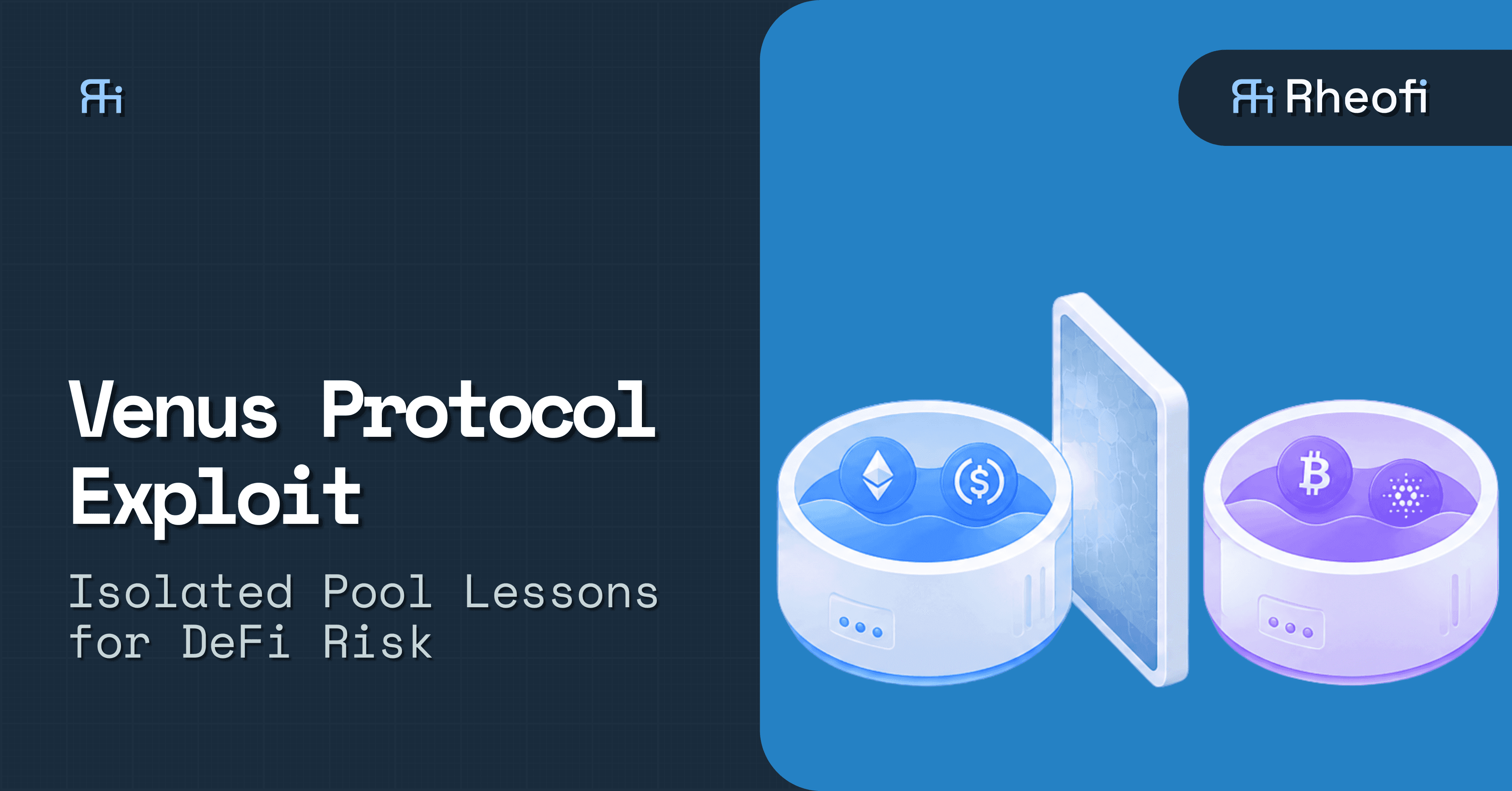
Venus Protocol's March 2026 donation attack generated $2.15M in bad debt confined to two isolated markets, confirming pool isolation limits contagion even when a single market is fully exploited (Rekt.news, March 2026). RheoFi's isolated-pool architecture applies the same per-pool Comptroller design that contained this damage to THE and CAKE markets alone.
Attack Vector Summary
The attacker spent nine months accumulating 12.2M THE tokens (84% of Venus's supply cap), funded by 7,400 ETH via Tornado Cash (Rekt.news, March 2026). By sending 36M THE tokens directly to the vTHE contract (not through mint()), the attacker bypassed supply cap enforcement and inflated the vTHE exchange rate 3.81x. This allowed borrowing CAKE tokens against an inflated collateral position. The oracle resisted the price manipulation for approximately 37 minutes before accepting the distorted feed; the primary bypass vector was supply cap logic, not oracle design.
How This Compares to Previous DeFi Lending Exploits
DeFi exploit losses peaked at $2.62B in 2022 and fell to $680M in 2025 (Immunefi, January 2025). Venus suffered three events in twelve months spanning phishing, donation attacks, and supply cap bypasses in 2025-2026. RheoFi's isolated-pool design draws lessons from each incident type.
DeFi Lending Exploit Comparison
| Protocol | Chain | Date | Loss | Attack Vector | Pool Design |
|---|---|---|---|---|---|
| Venus Protocol | BNB | Sep 2025 | $27M (funds recovered) | Phishing/social engineering | N/A (user attack) |
| Venus Protocol (ZKSync isolated) | ZKSync | Feb 2025 | $700K bad debt | Donation attack / supply cap bypass | Isolated pool |
| Venus Protocol (BNB Core Pool) | BNB | Mar 2026 | $2.15M bad debt | Donation attack / supply cap bypass | Isolated pool (partial) |
| Venus Protocol | BNB | May 2021 | ~$95M bad debt | XVS token price manipulation | Shared pool |
Why This Matters for Isolated Pool Architecture
DeFi lending protocols held $36.2B in total value locked as of June 2026 (DeFiLlama, June 2026). At that scale, a single shared-pool contagion event causes systemic withdrawals across unrelated markets. Isolated pool architecture severs that contagion path. RheoFi's pools each carry their own Comptroller, reserve fund, and collateral factors.
The Contagion Risk in Shared-Pool Designs
Shared-pool protocols run a single Comptroller. Undercollateralization in one asset affects every borrower and lender in the pool. In a shared pool, USDC depositors bear losses from an asset they never held. Isolated pools sever this channel.
How the Exploit Occurred
Venus Protocol's BNB Chain markets held approximately $1.1B in TVL at the time of the March 2026 donation attack (Rekt.news, March 2026). The attacker spent nine months accumulating 12.2M THE tokens before exploiting a supply cap bypass in the vTHE market. RheoFi's supply cap enforcement and Comptroller-per-pool design address both the contagion and the within-pool attack dimensions.
Donation Attack as Supply Cap Bypass
Donation attacks bypass supply cap enforcement by sending tokens directly to the vToken contract, not through mint(). Venus's ZKSync isolated deployment fell to the same technique in February 2025, generating $700K bad debt (Rekt.news, March 2026). The primary bypass was supply cap logic.
From the RheoFi Testnet: Whitepaper v1.0 Publication, April 14, 2026 Context: RheoFi Protocol published its first public whitepaper documenting full architecture and inherited audit lineage from Venus v4, including the isolated Comptroller system. Finding: The whitepaper disclosed 15 inherited audit engagements covering isolated-pool core, Comptroller, risk fund, and oracle integration: the exact subsystems implicated in Venus Protocol's March 2026 donation attack. Result: 15 inherited security engagements establish a documented audit baseline for RheoFi's isolated-pool Comptroller design before mainnet launch. Source: https://docs.rheofi.com/whitepaper/RheoFi_Whitepaper_v1.pdf
Key Facts: Timeline and On-Chain Data
Venus Protocol's March 2026 donation attack left $2.15M in unrecoverable bad debt, confirming that supply cap enforcement logic is a critical isolated-pool security layer (Rekt.news, March 2026). RheoFi inherits the Venus v4 isolated Comptroller design. No shared Comptroller exists in the RheoFi architecture.
Confirmed Facts as of July 2026
- Venus March 2026 donation attack: $2.15M bad debt in THE and CAKE markets.
- Attack vector (March 2026): Supply cap bypass via direct token transfer to vTHE contract.
- RheoFi: no shared-pool Comptroller. All markets isolated by design.
Isolated Pools. Contained Risk. Zero Cross-Pool Contagion.
RheoFi's isolated pool architecture ensures a liquidation event in one market cannot drain another. Every pool runs its own Comptroller on XRPL EVM Sidechain.
Built on Venus v4's battle-tested isolated pool design with 15 inherited audit engagements. Testnet live.
How Isolated Pool Protocols Should Respond
Venus v4's isolated Comptroller design limits bad debt to a single market per incident; the March 2026 THE-token attack left $2.15M in bad debt confined to two pools (Rekt.news, March 2026). The response checklist for isolated pool protocols is clear. RheoFi's architecture reflects these controls at the design level, not as a post-incident retrofit.
Protocol Response Checklist
- Audit oracle latency windows and BoundValidator deviation thresholds for each collateral asset's volatility profile.
- Confirm supply caps per isolated pool limit maximum loss in a worst-case oracle failure.
- Confirm no cross-pool reserve sharing exists in Comptroller configuration.
See RheoFi's Resilient Oracle Architecture and oracle documentation for configuration details.
If you are building on a Venus v4 fork right now: audit your supply cap enforcement path and verify that direct token transfers to vToken contracts cannot bypass cap logic.
Ongoing Risks: What to Watch
DeFi exploit losses fell from $2.62B in 2022 to $680M in 2025 (Immunefi, January 2025). Isolated pool containment addresses cross-market contagion but not within-pool vulnerabilities; donation attack supply cap bypasses are an active within-pool threat vector. RheoFi's multi-tier oracle and BoundValidator are the primary within-pool defenses.
Risk Indicators to Monitor
- Chainlink heartbeat intervals relative to volatility profiles of each collateral asset.
- BoundValidator deviation bounds as market conditions change for assets added by governance.
- Supply cap utilization per pool, which bounds maximum bad debt in an oracle failure.
See Risk Fund and Shortfall Auctions for RheoFi's backstop mechanism.
From the RheoFi Testnet: Three-Tier Resilient Oracle Configuration Context: RheoFi's Resilient Oracle system (MAIN/PIVOT/FALLBACK with BoundValidator) is designed for XRPL EVM, inheriting the oracle integration module from Venus v4's architecture. Finding: The BoundValidator architecture and deviation logic are covered across 15 inherited Venus v4 audit engagements, providing a within-pool price defense layer complementing isolated-pool contagion prevention. Result: Oracle subsystem is audit-covered before mainnet launch; live testnet validation results will be published upon completion (RheoFi Whitepaper v1.0, April 2026)
Regulatory Implications
MiCA Regulation 2023/1114 establishes operational resilience obligations covering DeFi-adjacent services across the EU's 450M+ person market (EUR-Lex, MiCA 2023/1114, June 2023). The September 2025 Venus incident shows why regulators focus on protocol architecture. RheoFi's isolated pool design limits incident impact, aligning with MiCA's resilience framing.
MiCA and DeFi Exploit Reporting
MiCA Article 23 requires CASPs to notify competent authorities of significant security incidents without undue delay. RheoFi is a protocol, not a registered CASP, but oracle redundancy, pool isolation, risk fund, and shortfall auction map directly to MiCA's operational resilience principles. MiCA applies to EU/EEA-based operators specifically; builders in other jurisdictions should obtain jurisdiction-specific legal counsel.
Conclusion: What This Means for RheoFi Protocol
Venus Protocol's March 2026 incident left $2.15M in bad debt despite isolated pool architecture containing damage to two markets (RheoFi Whitepaper v1.0, April 2026). RheoFi inherits 15 audit engagements from Venus v4, with isolated Comptrollers, risk fund, and BoundValidator oracle providing layered defense. Isolated-pool architecture is containment, not immunity.
RheoFi's Architectural Differentiators
RheoFi addresses this attack type via Comptroller-per-pool isolation, a 3-tier Resilient Oracle with BoundValidator, and a risk fund backstop per pool. See isolated pool configuration.
References
- Rekt.news, March 2026 — Rekt.news
- Immunefi, January 2025 — Immunefi
- DeFiLlama, June 2026 — DeFiLlama
- RheoFi Whitepaper v1.0, April 2026 — RheoFi Whitepaper v1.0
- EUR-Lex, MiCA 2023/1114, June 2023 — EUR-Lex
FAQs
The March 2026 exploit targeted Venus Protocol's THE token market on BNB Chain. An attacker sent 36M THE tokens directly to the vTHE contract, bypassing supply cap enforcement and inflating the vTHE exchange rate by 3.81x. This allowed borrowing CAKE tokens against the inflated position, leaving $2.15M in bad debt. Isolated pool architecture confined the damage to THE and CAKE markets only.